Two-Layer Lavender Honey Cake as a Showpiece Celebration Cake
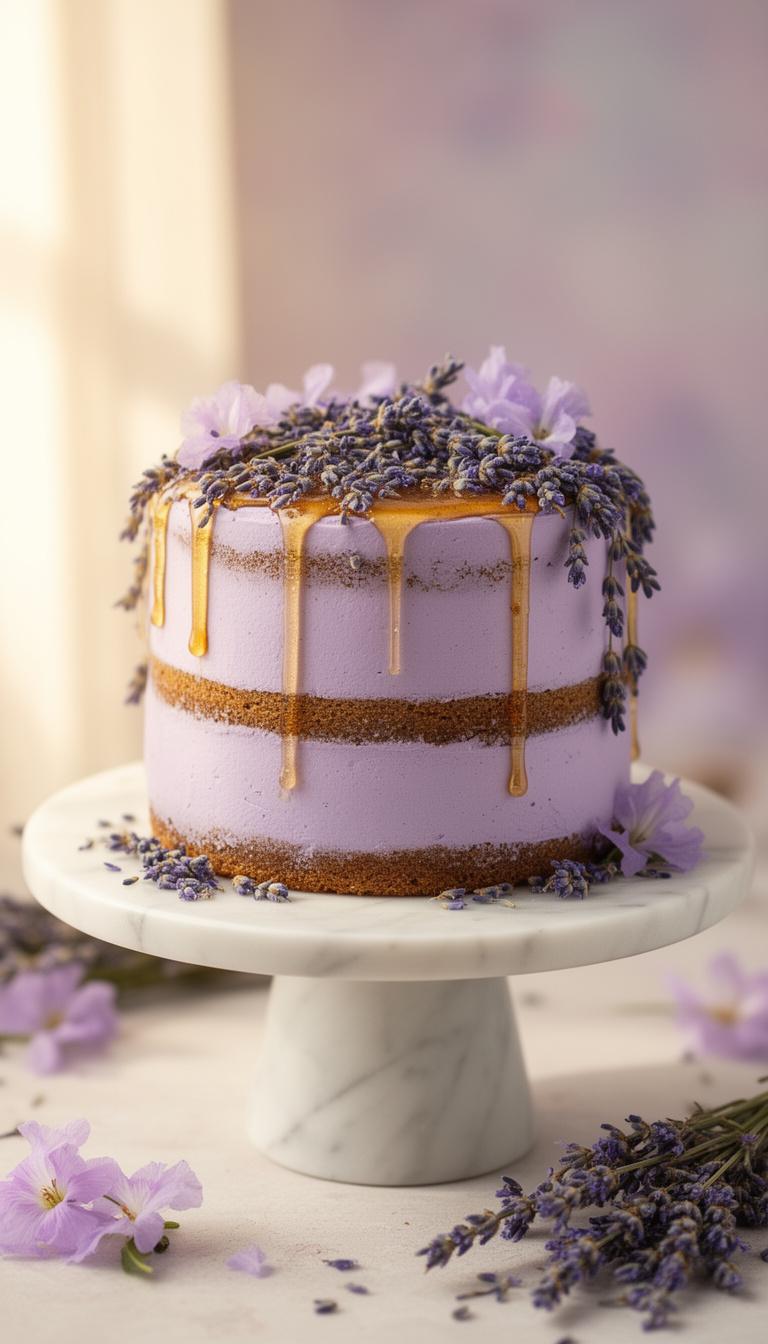
A two-layer lavender honey cake is exactly what it sounds like — a celebration cake built around floral, aromatic lavender and the deep sweetness of real honey, stacked and frosted with honey mascarpone buttercream.
It’s the kind of cake you’d bring to a birthday, bridal shower, or anniversary when you want something that looks and tastes genuinely considered. The lavender keeps it from being too sweet, and the honey gives it warmth that vanilla alone can’t.
It’s a hard recipe — not because any single step is tricky, but because it asks you to nail timing, temperature, and restraint all at once.
Choosing Lavender That Won’t Ruin the Cake
Culinary lavender is the only kind you should use here. Ornamental or craft lavender can be treated with pesticides and has a soapy, medicinal flavor that bakes in aggressively. Look for food-grade dried lavender buds, often sold at specialty grocery stores or online — brands like Frontier Co-op or Starwest Botanicals are reliable.
The amount matters more in this recipe than in most. Too little and you won’t taste it. Too much and the cake tastes like soap or perfume. One tablespoon of dried buds steeped in warm milk is the sweet spot for two 8-inch layers.
Trending on Amazon
Why Your Frosting Temperature Controls Everything
Honey mascarpone buttercream is softer and more temperature-sensitive than standard American buttercream. If your butter is too warm when you start, the frosting will be loose and won’t hold a clean edge. If the mascarpone is too cold, it’ll break the emulsion and look curdled.
Butter should be cool-room-temperature — it should give slightly when pressed but hold its shape. Mascarpone should come out of the fridge about 15 minutes before you use it. Chill the crumb-coated cake for at least 45 minutes before applying the final coat, or the frosting will drag and tear.
Two-Layer Lavender Honey Cake as a Showpiece Celebration Cake
Lavender Milk
Cake
Honey Mascarpone Buttercream
Decoration
- 🔪Two 8-inch round cake pans (2-inch depth)
- 🥣Stand mixer with paddle and whisk attachments, or hand mixer
- ⚡Small saucepan
- 🍳Fine mesh strainer
- 🥄Kitchen scale
- 📏Offset spatula (small and large)
- 🔧Bench scraper
- 🍰Cake turntable
- 🫙Wire cooling racks
- 🌡️Parchment paper
- 🔪Instant-read thermometer (optional but helpful)
Steep Lavender Milk
Combine 1 tablespoon dried culinary lavender buds with 1 cup whole milk in a small saucepan over medium-low heat. Warm the milk until it just begins to steam and small bubbles appear around the edges, about 3–4 minutes — don’t let it boil.
Remove from heat, cover, and steep for 20 minutes. Strain through a fine mesh strainer, pressing the buds gently to extract all the liquid.
Discard the buds. You should have about 1 cup of lavender milk.
Let it cool to room temperature before using.
Prep the Pans
Preheat your oven to 350°F (175°C). Grease two 8-inch round cake pans with butter or nonstick spray, line the bottoms with parchment circles, then grease the parchment.
Dust lightly with flour and tap out the excess. Set aside.
Combine Dry Ingredients
In a medium bowl, whisk together 2 ½ cups all-purpose flour, 2 ½ teaspoons baking powder, and ½ teaspoon fine sea salt. Set aside.
Cream Butter and Sugar
In the bowl of a stand mixer fitted with the paddle attachment, beat ¾ cup room-temperature butter on medium speed for 2 minutes until pale and creamy. Add 1 ¼ cups granulated sugar and beat on medium-high for 3–4 minutes, scraping down the sides twice, until the mixture is noticeably lighter in color and fluffy.
Stream in ⅓ cup honey and beat for another 1 minute.
Add Eggs and Vanilla
With the mixer on medium-low, add the 3 eggs one at a time, waiting until each is fully incorporated before adding the next — about 20 seconds per egg. Scrape down the bowl after the last egg.
Add 2 teaspoons vanilla extract and mix for 10 seconds. The batter may look slightly curdled at this stage; that’s normal and will smooth out.
Alternate Flour and Milk
With the mixer on low, add the flour mixture in three additions, alternating with the cooled lavender milk in two additions — starting and ending with flour. Mix each addition only until just combined, about 10–15 seconds.
When the last flour addition is mostly incorporated, stop the mixer and finish folding by hand with a spatula, scraping the bottom of the bowl to catch any unmixed pockets. Don’t overmix — the batter should be smooth and thick, not elastic.
Bake the Layers
Divide the batter evenly between the two prepared pans — a kitchen scale is the most reliable method, targeting roughly 600–620g per pan. Smooth the tops with an offset spatula.
Bake at 350°F for 30–35 minutes, rotating the pans once at the 20-minute mark. The cakes are done when the tops are golden and spring back when lightly pressed in the center, a toothpick inserted in the middle comes out with a few moist crumbs (not wet batter), and the edges have just begun to pull away from the pan sides.
Cool the Layers
Let the cakes cool in their pans on wire racks for 20 minutes. Run a thin knife around the edges, then invert onto the racks, peel off the parchment, and flip right-side up.
Allow to cool completely — at least 1 hour at room temperature. Don’t frost warm cakes; the buttercream will melt and slide.
Make the Buttercream
In the stand mixer fitted with the paddle attachment, beat 1 ½ cups cool-room-temperature butter on medium speed for 3–4 minutes until smooth and lighter in color. Add the mascarpone and beat on medium for 1 minute until just combined — don’t overbeat mascarpone or it can become grainy.
Add the sifted powdered sugar one cup at a time on low speed, then add 3 tablespoons honey, 2 tablespoons heavy cream, ½ teaspoon salt, and 1 teaspoon vanilla. Increase to medium-high and beat for 2 minutes.
The frosting should be smooth, glossy, and hold a soft peak. If it looks loose, refrigerate for 10–15 minutes and beat briefly again.
Crumb Coat and Chill
Place one cooled cake layer on a cake board or turntable. Spread about ¾ cup of buttercream evenly across the top using an offset spatula, going all the way to the edges.
Place the second layer on top, pressing gently to level it. Apply a thin, uneven crumb coat of buttercream over the entire cake — top and sides — using the offset spatula and bench scraper.
Don’t worry about perfection here; you’re just sealing in the crumbs. Refrigerate uncovered for 45 minutes to 1 hour until the crumb coat is firm to the touch.
Apply Final Coat
Apply the final coat of buttercream. Scoop a generous amount onto the top and spread outward over the edges.
Add frosting to the sides and use the bench scraper held at a slight angle against the cake while rotating the turntable in one smooth motion to smooth the sides. Use the offset spatula to pull any excess from the top edge inward.
Aim for clean but not sterile — slight texture and visible strokes look intentional and beautiful on a rustic celebration cake. Refrigerate for 30 minutes before decorating.
Decorate and Serve
Remove the cake from the refrigerator. Drizzle 2–3 tablespoons of raw honey over the top, letting it run naturally down the sides in uneven rivulets — work quickly as honey moves slowly on cold frosting.
Arrange fresh or dried lavender sprigs on top in a loose cluster off-center, and scatter edible dried flowers if using. Serve the cake at room temperature; pull it from the fridge at least 30 minutes before slicing so the frosting softens and the crumb is tender rather than dense and cold.
Per serving (1 slice (1/12 of cake)) — values are estimates
Our Best Picks