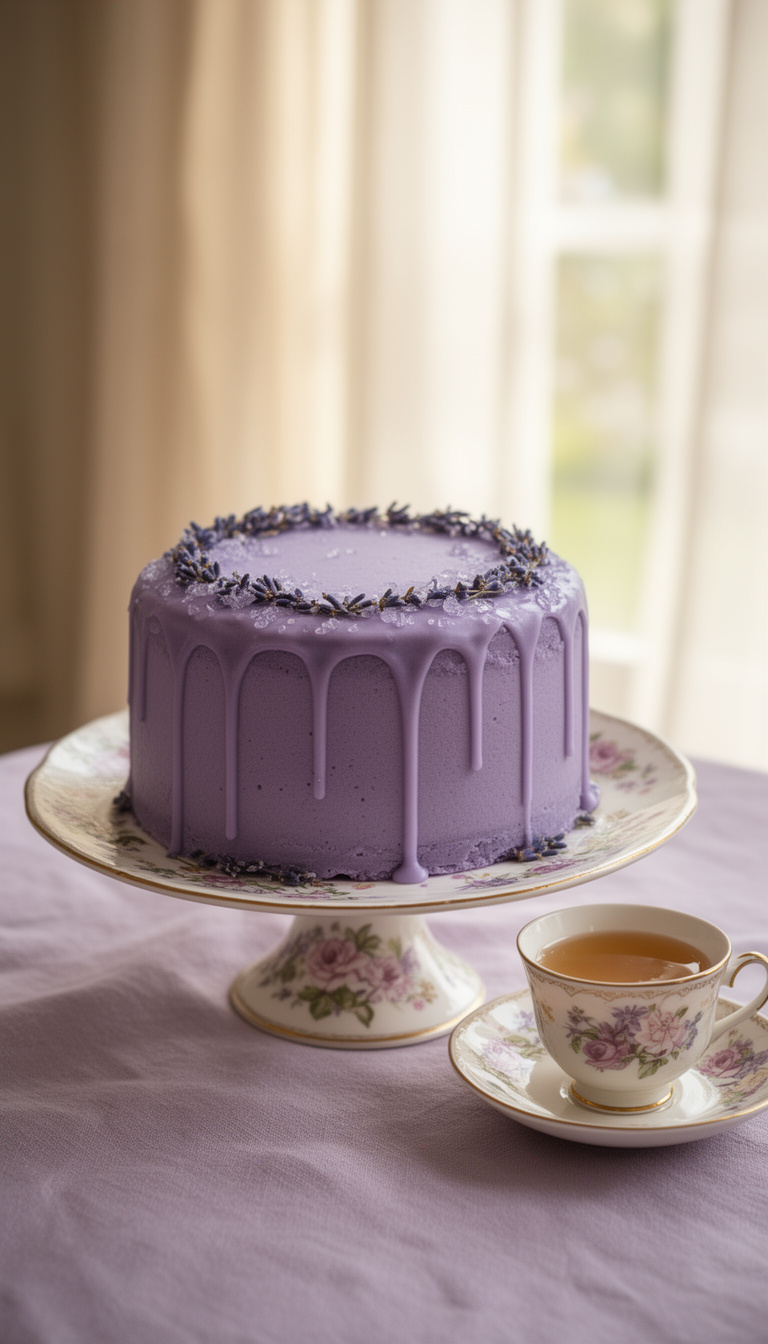
Lavender Honey Cake
Lavender honey cake is a fragrant, lightly floral sponge glazed with warm honey — the kind of cake that feels elegant without requiring any special skill.
It’s worth making when you want something that stands out from the usual chocolate or vanilla rotation. The lavender stays subtle if you measure carefully, and the honey keeps every slice moist for days.
You’ll find it works beautifully for afternoon tea, a casual dinner party, or just a quiet weekend bake.
Choosing and Using Culinary Lavender
Not all lavender is the same. You want culinary-grade dried lavender buds — usually English lavender (Lavandula angustifolia) — which has a sweeter, less medicinal flavour than French varieties. Avoid anything sold as decorative or ornamental lavender, since it may contain pesticides or have a sharp, soapy edge.
A little goes a long way. One teaspoon of dried buds steeped in warm butter is enough to flavour the whole cake without tasting like soap. If you’re new to baking with lavender, err on the side of less.
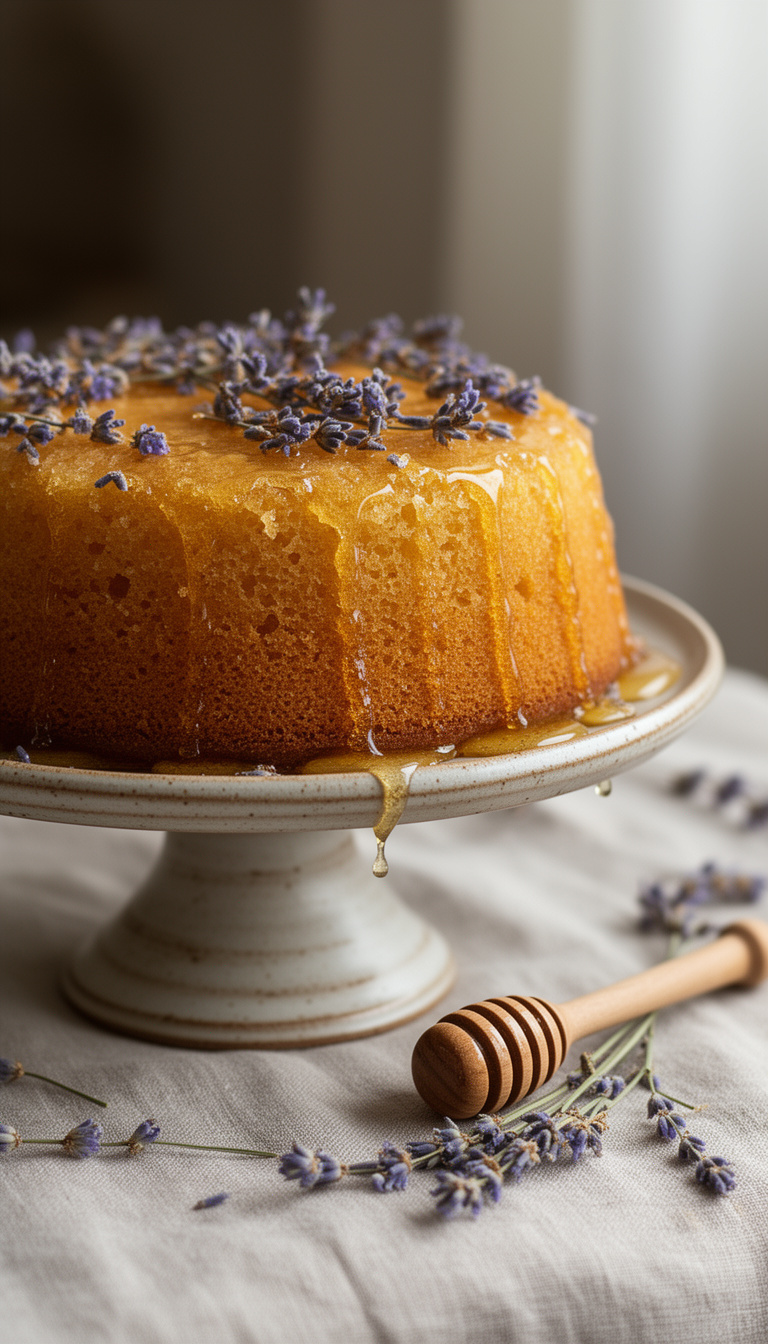
Editor’s Choice


Getting the Honey Glaze Right
The glaze is where most of the honey flavour lives, so the type you choose matters. A mild wildflower or acacia honey keeps things delicate. A stronger buckwheat or manuka honey will push the flavour in a more intense, earthy direction — not bad, just different.
Pour the glaze over the cake while it’s still slightly warm, not hot. A hot cake will absorb the glaze too fast and lose the glossy finish. A fully cooled cake won’t let the glaze soak in at all, leaving it sitting on the surface rather than melting in slightly at the edges.
Storage and Make-Ahead Notes
- Store the glazed cake covered at room temperature for up to 3 days — the honey actually keeps the crumb moist longer than a standard butter cake.
- You can bake the unglazed cake a day ahead, wrap it tightly in plastic wrap, and apply the glaze the day you plan to serve it.
- For a layered version, split the cooled cake horizontally and spread whipped cream or a honey mascarpone filling between the layers before glazing the outside.
- If culinary lavender is unavailable, 1/2 tsp of food-grade lavender extract added directly to the batter works as a substitute — but start with less and taste as you go.
- Room temperature eggs and milk are not optional here. Cold dairy and eggs cause the batter to seize around the butter, leading to a denser, uneven crumb.
Lavender Honey Cake
Lavender Butter
Cake Batter
Honey Glaze
Garnish
- 🔪23cm (9-inch) round springform or loose-bottomed cake tin
- 🥣Small saucepan
- ⚡Fine mesh sieve or tea strainer
- 🍳Stand mixer or electric hand mixer
- 🥄Large mixing bowl
- 📏Medium mixing bowl
- 🔧Rubber spatula
- 🍰Wire cooling rack
- 🫙Skewer or toothpick
- 🌡️Small saucepan for glaze
- 🔪Pastry brush
Prep the Tin
Preheat your oven to 170°C (340°F) fan, or 180°C (355°F) conventional. Grease your 23cm cake tin with butter and line the base with parchment paper.
Set aside.
Steep the Lavender
Melt the butter in a small saucepan over low heat. Once melted, remove from the heat and stir in 1 tsp dried lavender buds.
Let the mixture steep for 10 minutes — the butter will take on a faint floral scent. Strain through a fine mesh sieve into a bowl, pressing the buds gently to extract all the butter.
Discard the buds and allow the lavender butter to cool to room temperature, about 15 minutes. It should be soft and opaque, not liquid.
Cream Butter and Sugar
Beat the cooled lavender butter and caster sugar together in a stand mixer fitted with the paddle attachment, or in a large bowl with a hand mixer, on medium-high speed for 4–5 minutes until the mixture is pale, noticeably fluffy, and has increased in volume. Scrape down the sides of the bowl halfway through.
Add Eggs and Honey
With the mixer running on medium speed, add the 3 tablespoons of honey and mix for 30 seconds. Add the eggs one at a time, waiting for each to fully incorporate before adding the next — about 20 seconds per egg.
Add the vanilla extract with the final egg. If the mixture looks slightly curdled at any point, don’t worry; it will come together once the flour is added.
Fold in Flour
In a separate bowl, whisk together the flour, baking powder, and salt. With the mixer on low speed, add the flour mixture in three additions, alternating with the milk in two additions (flour, milk, flour, milk, flour).
Start and end with flour. Mix only until just combined after each addition — overmixing at this stage will tighten the crumb.
Stop the mixer as soon as no dry streaks remain and fold once or twice by hand with a rubber spatula.
Bake the Cake
Scrape the batter into the prepared tin and smooth the top with a spatula. Bake on the middle rack for 32–38 minutes.
The cake is done when the top is deep golden and springs back when lightly pressed in the centre, a skewer inserted into the middle comes out clean or with just a few dry crumbs, and the edges have just started to pull away from the sides of the tin. If the top browns too quickly before the centre sets, loosely tent with foil after 25 minutes.
Cool in Tin
Remove the cake from the oven and let it cool in the tin for 10 minutes. Run a thin knife around the edge, then release and transfer to a wire rack.
Allow to cool for another 20–25 minutes until just slightly warm — not hot.
Warm the Glaze
While the cake cools, combine the 4 tablespoons of honey and lemon juice in a small saucepan over low heat. Stir gently for 1–2 minutes until the honey loosens and the mixture is warm and fluid.
Don’t let it boil. Remove from heat.
Glaze and Rest
Place the still-slightly-warm cake on the wire rack set over a tray or plate to catch drips. Use a pastry brush to generously coat the top and sides with the warm honey glaze, letting it soak in before applying a second coat.
If you’d like, scatter a pinch of dried lavender buds over the top while the glaze is still tacky. Allow the cake to rest at room temperature for at least 30 minutes before slicing so the glaze sets and the crumb firms up.
Dust lightly with powdered sugar just before serving if desired.
Per serving (1 slice (1/10 of cake)) — values are estimates