Mother’s Day Fruit Tart
A French fruit tart is a buttery shortcrust shell filled with silky vanilla pastry cream, then topped with fresh fruit arranged in a way that looks like it took far more effort than it did.
It’s the kind of dessert that feels genuinely celebratory without requiring professional skills. The components can be made ahead, so you’re not scrambling on the day itself.
Each element is straightforward on its own — it’s the assembly that pulls everything together into something worth presenting.
Getting Pastry Cream Right the First Time
Pastry cream (crème pâtissière) thickens on the stove, and the step most people fumble is losing their nerve and pulling it off the heat too early. You need to keep whisking and let it come to a full, bubbling boil for at least 60 seconds — that’s what cooks out the starchy taste from the cornstarch.
If lumps appear, don’t panic. Strain the finished cream through a fine-mesh sieve. Press plastic wrap directly onto the surface before chilling to prevent a skin from forming.

Most Loved Products
Choosing and Arranging Your Fruit
Use fruit that won’t release too much liquid or oxidize quickly once cut. Strawberries, raspberries, blueberries, kiwi, and mandarin segments all hold up well for several hours. Avoid watermelon, mango, or peaches — they weep and make the cream soggy fast.
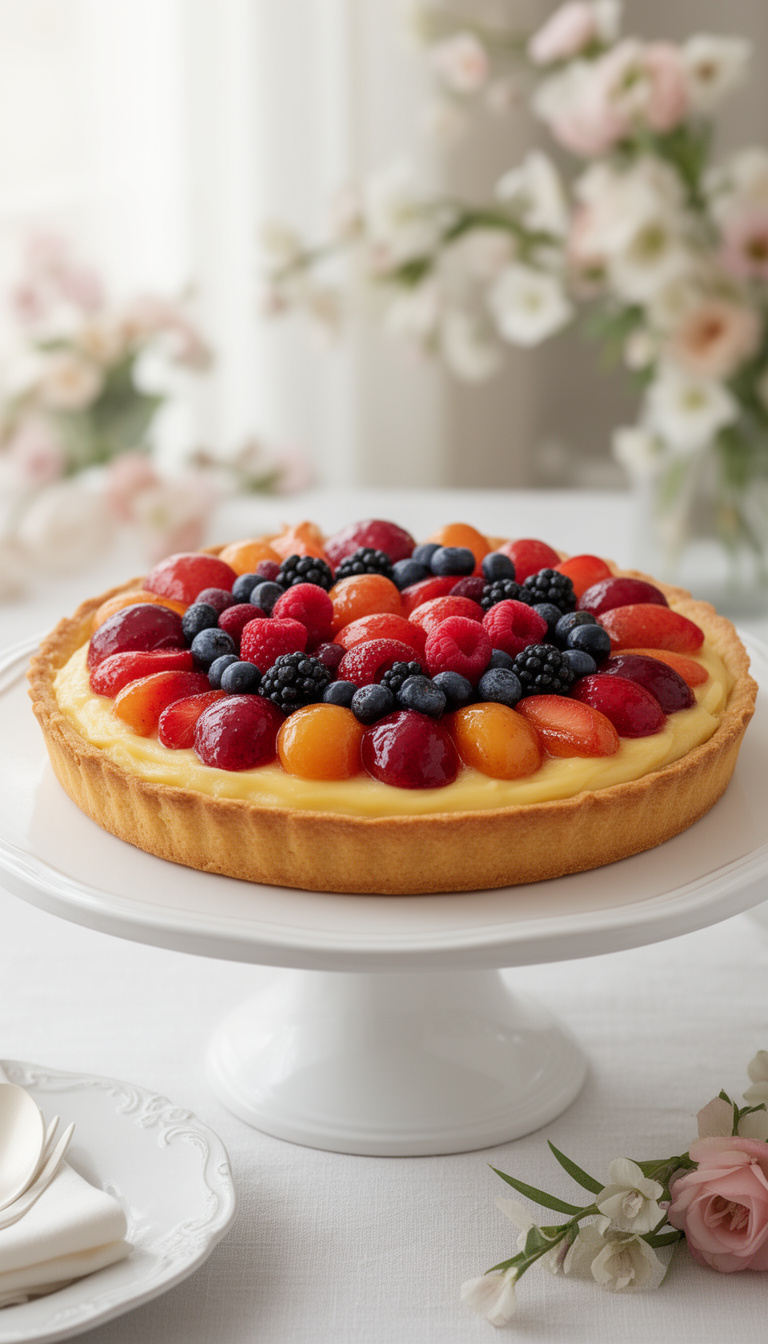
For the arrangement, work from the outside edge inward in concentric rings. You don’t need a pattern, but consistency in fruit size makes a big visual difference. A pastry brush and warm apricot glaze is what gives the tart that polished, glazed finish you see in French patisseries.
Mother’s Day Fruit Tart
Tart Shell (Pâte Sucrée)
Pastry Cream (Crème Pâtissière)
Fruit Topping
Apricot Glaze
- 🔪9-inch (23cm) fluted tart pan with removable bottom
- 🥣Food processor or pastry cutter
- ⚡Medium saucepan (2-quart capacity)
- 🍳Whisk
- 🥄Fine-mesh sieve
- 📏Rolling pin
- 🔧Pie weights or dried beans
- 🍰Parchment paper
- 🫙Plastic wrap
- 🌡️Pastry brush
- 🔪Offset spatula
Make the Dough
In a food processor, pulse together the flour, powdered sugar, and salt for 5 seconds to combine. Scatter the cold butter cubes over the flour mixture and pulse 8–10 times until the mixture resembles coarse breadcrumbs with a few pea-sized butter pieces remaining.
In a small bowl, whisk together the egg yolk and cold water. Drizzle over the flour-butter mixture and pulse 4–5 more times until the dough just starts to clump — it won’t fully come together in the processor.
Rest the Dough
Turn the dough out onto a lightly floured surface and press it together into a flat disc about 1 inch thick. Wrap tightly in plastic wrap and refrigerate for at least 30 minutes.
Cold dough is easier to roll and prevents the shell from shrinking during baking.
Line the Pan
Preheat your oven to 375°F (190°C). On a lightly floured surface, roll the chilled dough into a circle roughly 12 inches in diameter and about ⅛ inch thick.
Carefully drape the dough over your rolling pin and transfer it into the tart pan. Press the dough gently into the fluted edges, then roll the rolling pin across the top of the pan to trim any excess.
Prick the bottom all over with a fork, about 20 times.
Blind Bake Shell
Press a sheet of parchment paper into the tart shell and fill it with pie weights or dried beans, spreading them to the edges. Blind bake for 15 minutes, then carefully lift out the parchment and weights.
Return the shell to the oven and bake for another 8–10 minutes until the bottom looks dry and the edges are a light golden brown. Let the shell cool completely in the pan on a wire rack before filling, about 30 minutes.
Temper the Eggs
In a medium bowl, whisk together the egg yolks, sugar, and cornstarch until the mixture is pale and smooth, about 1 minute. In a medium saucepan over medium heat, warm the milk until it just begins to steam and small bubbles form around the edges — don’t let it boil.
Slowly pour about half the hot milk into the egg mixture in a thin stream, whisking constantly. Pour the tempered egg mixture back into the saucepan with the remaining milk.
Cook Pastry Cream
Cook the pastry cream over medium heat, whisking constantly, until it thickens and comes to a full bubbling boil. Hold it at a boil for 60 seconds while continuing to whisk — this step is essential to cook out the raw cornstarch flavor.
Remove from heat and immediately whisk in the butter and vanilla extract. Strain through a fine-mesh sieve into a clean bowl.
Press plastic wrap directly onto the surface and refrigerate until fully cold and set, at least 2 hours.
Fill the Shell
Once the pastry cream is cold, whisk it briefly to loosen it to a smooth, spreadable consistency. Spoon it into the cooled tart shell and spread evenly with an offset spatula, filling right to the edges.
The cream layer should be about ½ inch deep.
Arrange the Fruit
Arrange the fruit over the pastry cream starting from the outer edge and working inward in concentric rings. Place kiwi slices along the outer edge, then a ring of halved strawberries cut-side down, then raspberries, finishing with a cluster of blueberries in the center.
Keep the fruit pieces close together so the cream underneath is mostly covered.
Glaze and Finish
In a small saucepan, warm the apricot jam and water together over low heat, stirring until the jam melts and the mixture is fluid, about 2 minutes. Strain through a fine-mesh sieve to remove any fruit solids.
Using a pastry brush, lightly dab the warm glaze over all the fruit — you want a thin, even coat that adds shine without pooling. The tart is ready to serve immediately or can be refrigerated uncovered for up to 4 hours.
The finished tart should have a glossy sheen across the fruit, a firm cream layer that holds its shape when sliced, and a shell that snaps cleanly rather than bending.
Per serving (1 slice (1/8 of tart)) — values are estimates
Our Best Picks