Mother’s Day Fruit Tart with Vanilla Pastry Cream from Scratch
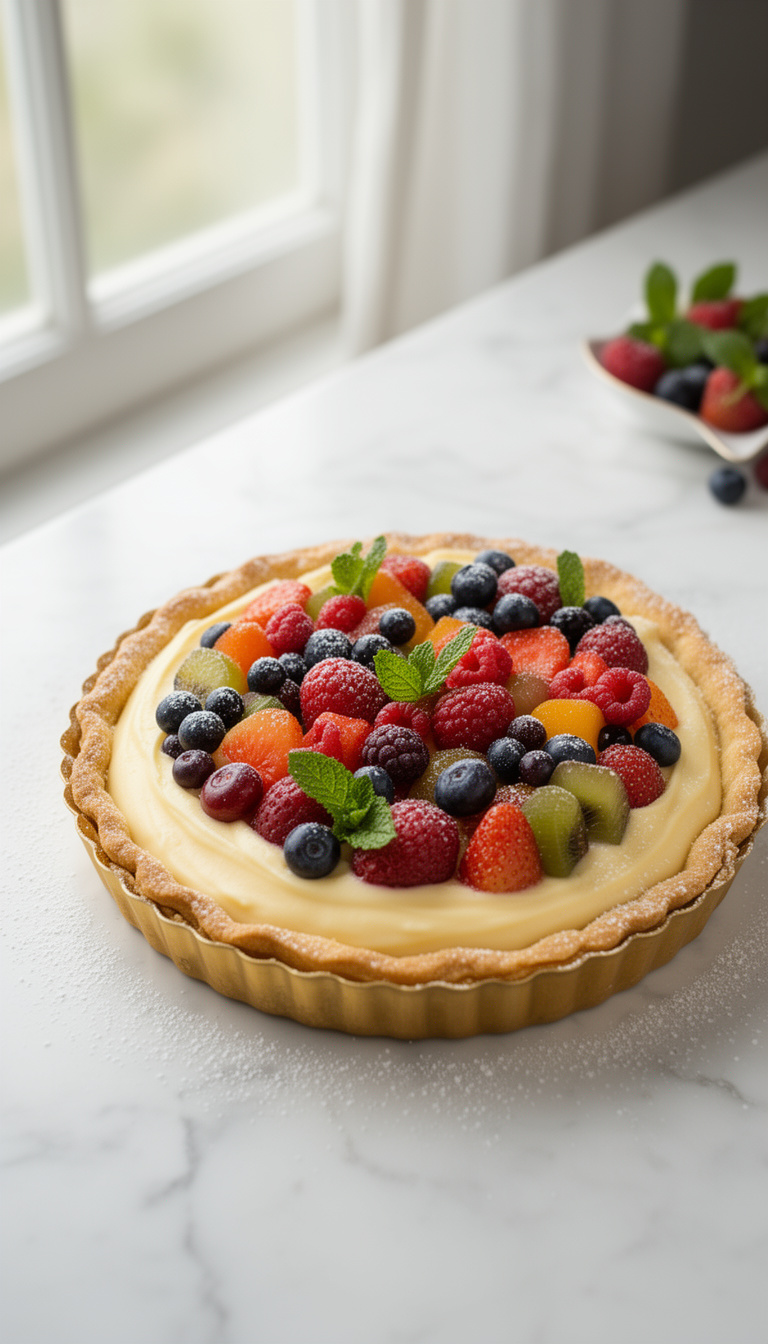
A French fruit tart is a buttery shortcrust shell filled with silky vanilla pastry cream and topped with fresh seasonal fruit — it’s one of those desserts that looks like it came from a patisserie window but is absolutely achievable at home.
It’s worth making for Mother’s Day because every component can be prepared a day ahead, so you’re not scrambling the morning of. The tart shell, the pastry cream, even the fruit prep — all done in advance.
The payoff is real: a crisp, golden shell that holds its shape when sliced, cream that’s rich without being heavy, and fruit that stays glossy and fresh. It takes patience, but none of the steps are beyond a careful home cook.
Getting Your Pastry Cream Right the First Time
Pastry cream fails in two common ways: it’s either lumpy from scrambled eggs or thin because the starch didn’t fully cook out. Both problems are avoidable. Whisk the egg yolks and sugar until pale before adding the hot milk — this tempers the eggs gradually rather than shocking them. Once the cream hits the stove, keep whisking constantly and don’t pull it off the heat the moment it thickens. Let it bubble for a full 60 to 90 seconds so the cornstarch cooks through completely, otherwise it’ll thin out as it cools.
Press plastic wrap directly against the surface before refrigerating to prevent a skin from forming.
Top Picks Today


Blind Baking a Shell That Stays Crisp
A soggy tart bottom usually comes down to one of three things: under-baked pastry, skipping the dock-and-weight step, or filling the shell while it’s still warm. Pâte sucrée needs to be chilled thoroughly before it goes into the oven — at least 30 minutes — so the butter stays cold and the shell holds its shape against the sides of the tin. Use pie weights or dried beans over parchment, and don’t rush removing them. The shell should look dry and set before you pull the weights and return it for the final browning. Let it cool completely before adding any cream.
Make-Ahead and Storage Notes
- The tart shell can be blind baked up to 2 days ahead and stored at room temperature in an airtight container.
- Pastry cream keeps refrigerated for up to 2 days with plastic wrap pressed directly on the surface.
- Assemble the tart no more than 6 hours before serving to keep the shell from softening.
- If the pastry cream has lumps after cooking, pass it through a fine-mesh strainer while still hot.
- Cold butter is non-negotiable for the tart shell — if your kitchen is warm, work quickly and chill the dough again if it softens before lining the pan.
Mother’s Day Fruit Tart with Vanilla Pastry Cream from Scratch
Pâte Sucrée (Tart Shell)
Vanilla Pastry Cream
Fruit Topping
Glaze
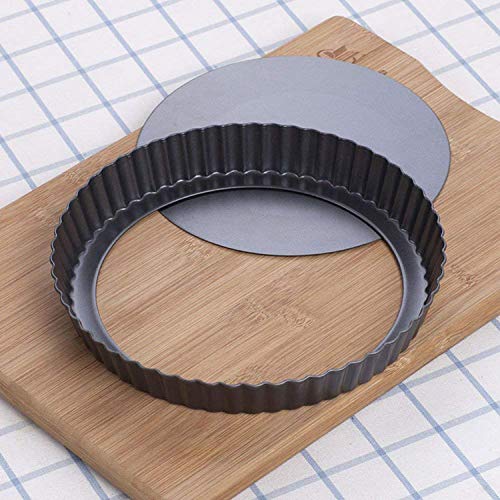
- 🔪9-inch (23cm) fluted tart pan with removable bottom
- 🥣Stand mixer or food processor (optional, for pastry)
- ⚡Medium saucepan (2-quart capacity)
- 🍳Whisk
- 🥄Fine-mesh strainer
- 📏Rolling pin
- 🔧Pie weights or 1½ cups dried beans
- 🍰Parchment paper
- 🫙Pastry brush
- 🌡️Offset spatula or palette knife
- 🔪Plastic wrap
- 🥣Instant-read thermometer (optional but helpful)
Make the Dough
Combine 1½ cups flour, ¼ cup powdered sugar, and ¼ teaspoon salt in a food processor (or a large bowl). Add ½ cup cold cubed butter and pulse 8 to 10 times until the mixture looks like coarse, pea-sized crumbs — some larger butter pieces are fine.
Add 1 egg yolk and 2 tablespoons ice water, then pulse or stir just until the dough begins to clump together. Squeeze a small piece; if it holds, it’s ready.
If it crumbles, add ice water one teaspoon at a time. Turn the dough onto a lightly floured surface and press it into a flat disc without overworking it.
Chill the Dough
Wrap the dough disc tightly in plastic wrap and refrigerate for at least 1 hour, or up to 2 days. Don’t skip this step — chilling relaxes the gluten and firms the butter, which keeps the shell from shrinking in the oven.
If you’re short on time, 30 minutes in the freezer works as a substitute.
Roll and Line
Remove the dough from the refrigerator and let it sit at room temperature for 5 minutes — just enough to make it pliable without warming the butter. On a lightly floured surface, roll it into a circle about 12 inches in diameter and ⅛ inch thick, rotating the dough a quarter turn after each pass to keep it even.
Carefully drape the dough over your rolling pin and unroll it over the tart pan. Press it gently into the fluted edges without stretching — stretching causes shrinkage.
Roll the pin over the top of the pan to trim the excess cleanly. Prick the base all over with a fork, then refrigerate the lined shell for 30 minutes.
Blind Bake Shell
Preheat the oven to 375°F (190°C). Line the chilled tart shell with a sheet of parchment paper, pressing it into the corners, then fill with pie weights or dried beans.
Bake for 15 minutes until the edges look dry and set. Carefully lift out the parchment and weights, then return the shell to the oven for another 10 to 15 minutes until the base is golden and fully dry to the touch.
It should look evenly golden across the bottom with no pale or soft patches. Let the shell cool completely in the pan on a wire rack before filling — at least 30 minutes.
Warm the Milk
Pour 2 cups whole milk into a medium saucepan. If using a vanilla bean, add the split pod and scraped seeds now.
Heat over medium heat until the milk just begins to steam and small bubbles appear around the edges — about 4 to 5 minutes. Don’t bring it to a full boil.
Remove from heat and let the vanilla steep for 5 minutes if using a pod, then remove the pod. If using vanilla extract, you’ll add it later.
Whisk Egg Base
In a medium bowl, whisk together 4 egg yolks and ½ cup granulated sugar vigorously for about 2 minutes until the mixture turns pale yellow and falls from the whisk in a thick ribbon. Sift in 3 tablespoons cornstarch and whisk again until completely smooth with no lumps visible — any unincorporated cornstarch will create lumps in the finished cream.
Temper the Eggs
Slowly pour about ½ cup of the warm milk into the egg mixture in a thin, steady stream while whisking constantly. Don’t rush this — adding too much hot milk at once will scramble the yolks.
Once the first addition is incorporated, pour in the remaining milk gradually, still whisking. Pour the entire mixture back into the saucepan through a fine-mesh strainer to catch any bits that may have cooked.
Cook the Cream
Set the saucepan over medium heat and whisk constantly, making sure to reach the edges and bottom of the pan. After 3 to 5 minutes, the cream will begin to thicken noticeably.
Keep whisking — don’t stop or walk away. Once it reaches a full boil and large bubbles break the surface, continue cooking and whisking for exactly 60 to 90 seconds.
The cream should be thick enough to hold a trail from the whisk and coat the back of a spoon heavily. Remove from heat immediately.
Finish the Cream
Off the heat, whisk in 2 tablespoons cubed butter one piece at a time until each piece is fully melted and incorporated. If using vanilla extract instead of a bean, stir it in now.
Pour the pastry cream into a clean shallow bowl or container, then press a sheet of plastic wrap directly onto the surface so it touches the cream completely — no air gaps. Refrigerate for at least 2 hours until cold and firm.
The cream can be made up to 2 days ahead.
Fill the Shell
Once both the shell and pastry cream are fully cooled, remove the tart shell from the pan and place it on a serving plate or board. Whisk the chilled pastry cream briefly to loosen it — it will have firmed up considerably.
Spoon it into the shell and spread it into an even layer with an offset spatula, coming right to the edges. The layer should be about ¾ inch thick and completely smooth on top.
Arrange the Fruit
Pat all the fruit dry with paper towels — any moisture will make the glaze slide off and can weep into the cream. Arrange the fruit in whatever pattern you like: concentric circles starting from the outside edge, a casual scattered arrangement, or organized sections by fruit type all work well.
Start with the larger pieces like strawberry halves and kiwi slices to anchor the design, then fill gaps with blueberries and raspberries.
Glaze and Serve
Combine ¼ cup apricot jam and 1 tablespoon water in a small saucepan over low heat, stirring until the jam melts and the mixture is smooth — about 2 minutes. Strain through a fine-mesh sieve if the jam has large fruit pieces.
Let it cool for 2 minutes until slightly thickened but still fluid. Using a pastry brush, apply a thin, even coat over all the fruit.
The glaze should look glossy and translucent, not thick or white. Refrigerate the finished tart for at least 30 minutes before slicing.
The shell stays crisp for up to 6 hours after filling; slice with a sharp knife wiped clean between cuts.
Per serving (1 slice (1/8 of tart)) — values are estimates